
Semantic Fidelity Verification
Run cosine similarity checks on output ASTs to ensure zero logic degradation post-compression.
OPEN-SOURCE DIAGNOSTIC RULER
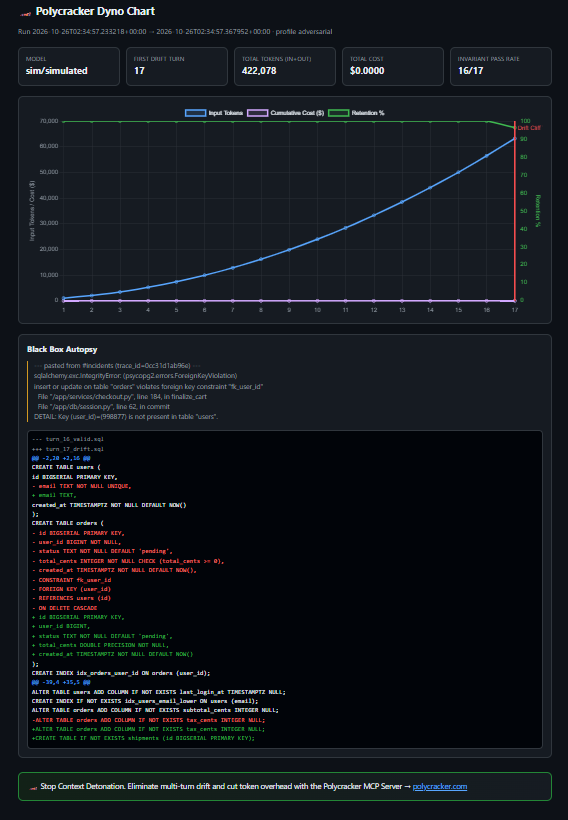
Benchmark multi-turn context drift, token accumulation, and invariant pass rates against adversarial profiles.
Polydyno is the open-source LLM dynamometer for SecOps and staff engineers: quantify input vs output token usage, benchmark latency and 429 TPM headroom, and prove 50–70% cost reduction before you deploy Polycracker ECU or Tuning House policies.
Run cosine similarity checks on output ASTs to ensure zero logic degradation post-compression.
Community tuners post verified Polydyno sheets on Discord, compete in weekly Token Drag Races, and compare Stage 2 & Stage 3 maps across TypeScript, Python, and Rust monorepos.
Enter the Discord Paddock →
Log completion_tokens from each model response in Polydyno pull sheets, then compare Stock vs Tuned runs after
Polycracker ECU compression on the same task prompts. See
how to test LLM token usage.
Record prompt_tokens and completion_tokens per turn in your harness; Polydyno aggregates per-repo baselines so you
can see whether bloat is intake-heavy or output-verbose.
Run adversarial Polydyno profiles on representative monorepo tasks, export token deltas, then calibrate Tuning House maps. See fix LLM input/output bloat.
Polydyno includes semantic fidelity checks on output structure so teams can verify AST-pruned prompts do not degrade logic before production rollout. Compare with AST pruning vs prompt compression.